



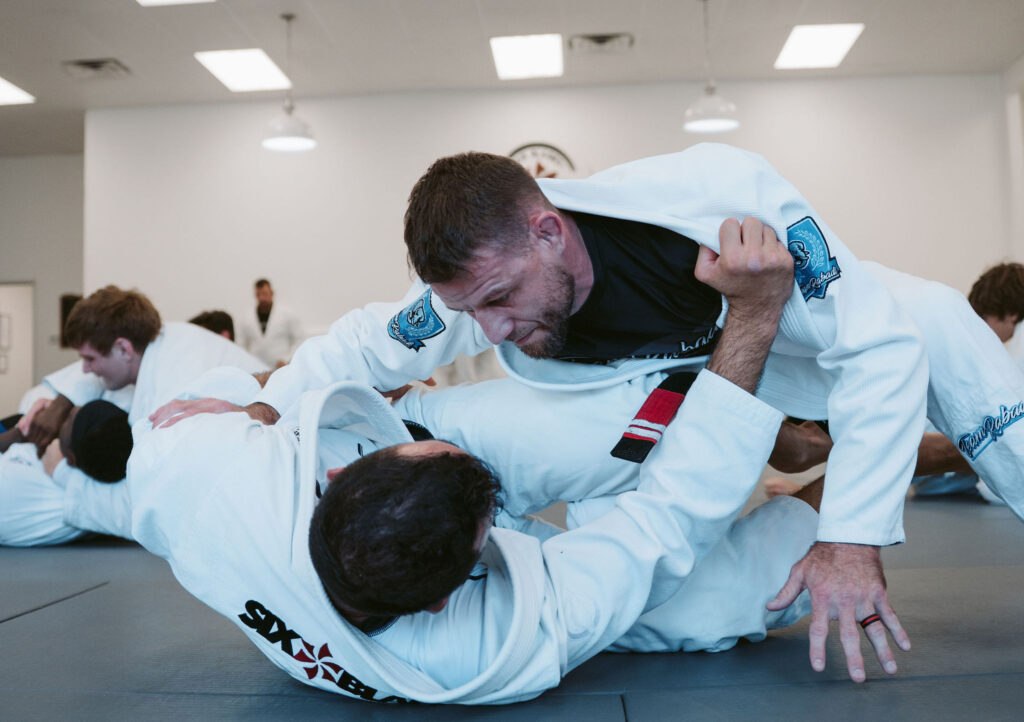
Whether you’re a La Quinta parent watching your child train or an adult stepping onto the mats for the first time, understanding the classic positions of Brazilian jiu jitsu makes the entire journey feel clearer and more enjoyable.
Jiu jitsu isn’t about size or strength — it’s about knowing how to control space, stay calm in uncomfortable situations, and use technique to create opportunities. These skills come from mastering foundational positions that appear in nearly every class.
Here’s a friendly breakdown of the most important positions you’ll encounter — and why they matter so much for beginners.
Closed Guard — Where Control and Confidence Begin
Closed guard is one of the very first lessons beginners learn. In this position, you’re on your back with your legs wrapped around your partner’s waist, securing their posture and limiting their movement.
Closed guard teaches new students how to:
- maintain control even from the bottom
- use their legs for leverage
- stay connected to their partner
- transition into attacks or sweeps
- manage distance safely
Many La Quinta students find this position empowering because it shows that being underneath doesn’t mean you’re losing — you’re actually in a strong attacking position when used correctly.
Open Guard — Building Movement, Timing, and Creativity
As beginners get more comfortable, they expand into open guard. Here, your legs are not locked, giving you freedom to move, hook, frame, and redirect pressure.
Open guard helps students develop:
- agility and footwork
- distance management
- transitions between guards
- grip strategy
- setups for sweeps and submissions
Open guard encourages curiosity and experimentation, making it a favorite among both kids and adults in La Quinta.
Half Guard — A Position of Defense, Patience, and Opportunity
Half guard sits between offense and defense. Beginners often think it’s a “bad spot,” but in reality, half guard gives you strong options for recovery and attacks.
From half guard, students learn to:
- block passing attempts
- establish underhooks
- create frames
- regain full guard
- sweep their partner
This position teaches patience — one of the most valuable lessons in jiu jitsu and everyday life.
Side Control — Learning Pressure and Stability
Side control is one of the most dominant top positions in the art. When you secure side control, you stabilize your partner’s hips and shoulders, limiting their movement and setting up strong attacks.
Beginners practice side control to learn:
- top pressure without force
- how to stay balanced
- transitions to mount or back control
- isolating arms for submissions
For La Quinta students, mastering side control builds confidence in maintaining control over an opponent in a safe, technical way.
Mount — Control, Confidence, and Clear Opportunity
Mount places you on top of your partner’s torso, giving you a strong base and multiple submission opportunities. It’s a position that teaches both dominance and emotional calm.
From mount, students learn to:
- maintain balance
- manage their partner’s movement
- apply pressure efficiently
- set up chokes and arm locks
Mount is especially important for beginners because learning to both escape and maintain this position builds resilience and awareness.
Back Control — The Most Advantageous Position in Jiu Jitsu
Back control is widely recognized as the strongest position in BJJ. With both hooks in and control over your partner’s torso, you gain significant leverage and safety.
From back control, beginners practice:
- seatbelt control
- securing hooks
- preventing escapes
- finishing rear naked chokes
- transitioning to other submissions
It’s a position that rewards strategy, patience, and precision — all qualities we love to see in La Quinta students.
Submissions — The Finish That Comes After Position
While submissions are exciting, they’re never the first step. Jiu jitsu teaches that a strong position creates the opening for a high-percentage submission.
Common beginner submissions include:
- armbar
- rear naked choke
- Americana
- kimura
- triangle choke
- collar chokes
These techniques reinforce a key principle:
Position leads to control; control leads to submission.
Helping La Quinta Beginners Build Skill With Confidence
At Six Blades La Quinta, the goal is not just to teach techniques — it’s to help students feel comfortable learning at their own pace. By understanding classic jiu jitsu positions, beginners develop clarity, confidence, and a strong foundation that supports long-term improvement.
We remind all new students:
- progress takes time
- technique beats strength
- breathing is essential
- questions are encouraged
- every class is a step forward
Once beginners understand the positional roadmap, training becomes more enjoyable — and far more meaningful.